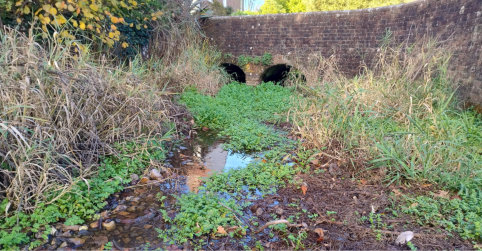
Campaigners are calling on the national environment watchdog to take urgent action to save a local chalk stream and the wildlife that depends on it.
In many places, the River Ems has run dry or been reduced to a trickle following the summer drought. Populations of key species have crashed alarmingly.
Campaigners say they want the Environment Agency (EA), set up to protect and improve the environment, to do its job. But it continues to allow Portsmouth Water to pump unsustainable amounts of water from the river’s underground sources.
And local citizen scientists who monitor the river’s wildlife say the agency has failed to respond to their findings.
They are calling on the EA to investigate the dramatic drop in river wildlife and urgently cut the amount of water that Portsmouth Water is allowed to remove.
The Ems runs from the South Downs into Chichester Harbour. It is fed by springs coming from the underground chalk bedrock, or aquifer, and flows from the South Downs through Westbourne, on the Hants/West Sussex border, before reaching the sea at Emsworth.
Chalk streams like the Ems are as internationally rare and ecologically important as coral reefs or rainforests. Rare species including water voles and eels have been recorded in the Ems, and local people have been used to seeing kingfishers, brown trout and many species of bat.
The campaign group Friends of the Ems (FOTE) has been pushing for a reduction in the amount of water taken – or “abstracted” – from the river’s sources. The EA controls an abstraction licence, dating back to the 1960s, which allows Portsmouth Water to keep removing water from the underground aquifer. The amount removed has steadily increased.
FOTE founder-member John Barker, a freshwater ecologist, lives on a farm in Westbourne. The Ems runs through his land and he regularly samples the river for key species that indicate its health. Around the country, much of this work used to be done by the EA but is now picked up by local people, under a partly EA-sponsored scheme.
He says: “Because of the lack of flow in the river, its all-important gravel habitats are smothered with algae and silt. Populations of small creatures have been near-decimated. They are needed as food by fish.
“I usually see thousands of freshwater shrimp in the river. But in recent sampling I haven’t seen any. In the most recent sample only two weeks ago, key groups of organisms were simply missing. Where I would be normally counting dozens of individuals of each type, in this sample there were just three individuals of only one type. It was horrifying.
“We have gone beyond the EA’s ‘trigger’ levels for these species. But despite us reporting our findings the EA has failed to respond as agreed.
“Portsmouth Water’s licence is due to be reviewed in 2028. But we need the EA to step in right now and reduce the amount of water the company can take.
“Already there isn’t enough flow in the river in the summer and autumn due to unsustainable levels of abstraction. Coupled with droughts like the one we’ve just had, the river is on its knees. Climate change and house building are making the situation worse.
“Portsmouth Water continuously abstracts almost 300 litres per second from the aquifer feeding the Ems, leaving the river flowing at about 20 litres per second in recent months.”
Friends of the Ems is part of local eco-group Greening Westbourne. To join the Friends, people can email greeningwestbourne@hotmail.co.uk
To find out more, people can search Greening Westbourne Campaign to see the group’s website, or find its page on Facebook.
Greening Westbourne is urging residents to save water. Tips on doing this are promoted by Portsmouth Water at www.portsmouthwater.co.uk/environment/saving-water