I’ve written about Roman roads, but there’s more to dowsing than that.
Dowsing is very commonly known for finding water, and particularly springs, but also underground pipes and cable ducts etc. But they can all be found using ground penetrating radar and other technological devices. Dowsing, on the other hand, can also find intangible things.
My last article wrote about a road running North, and it traced through to Staunton park, so it made me think about whether there was a North Street in Roman days. Certainly it didn’t run where North Street is now. In fact I traced it where the Chestnut Tree charity shop is now situated. From there it went North behind where the North Street shops now are. It went South to cross the old Roman Road from Chichester
The Roman cross roads was just South of where St Faiths is now, but there wasn’t always a church there. Before it was built there was a church at Warblington, but that was a good walk for the fit people of the Havant area, but the less able needed somewhere closer to conduct essential worship.
With permission from the Rector of St Faiths, I dowsed in the graveyard and found the suggestion of a small wooden building between the modern church and The Old House at Home. This was likely to have been what is called a Chapel of Ease. This would have been enough while the population was small, but it needed to get bigger as the population grew so the Saxons built a fine new stone Church where we see it now. The old wooden chapel continued in use during the years it took to build.
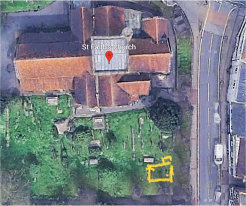
I wanted to check the size of this chapel and used a one handed method of dowsing. One doesn’t need two rods every time. I walked down South St. seeking the line of the north edge, when my rod tweaked over to the right I put a tiny chalk cross on the pavement and walked on to get the next edge and chalked the pavement. Similarly I walked along the path between the pub and the church ground to get the other measurement. So, I believe that the chapel was 28 feet long, and 12’ 6” wide with a 6’x6’ porch on the North side.
This old chapel was wooden built with the side walls just six feet high, but once inside the roof was Angled up to give a normal height pitched roof. On the North edge there was a porch towards the Eastern end, so it was a small but sturdy little chapel, ideal for less able worshippers.
This exercise led me to muse on what measurements were in use when the Saxon church was built.
It seems that feet and inches were in use, but their actual size varied from place to place in the country until they started to become standardised with the Winchester standards in the 15th century.
Amusingly the “rod” In the 16th century the rod (5.5 yards, or 16.5 feet) was defined as the length of the left feet of 16 men lined up heel to toe as they emerged from church.